An Invitation to Keep Asking – On Bodies of Sound: Becoming a Feminist Ear
by Emily Hilliard
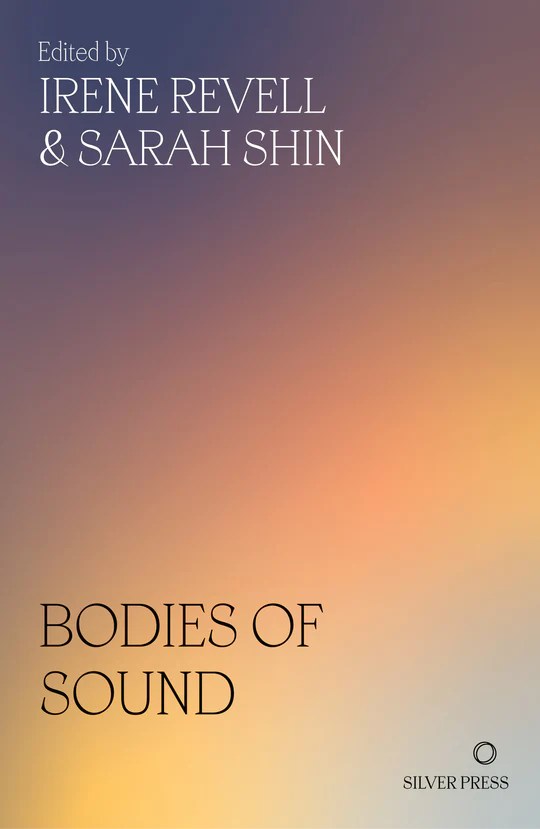
Edited by sound art curator, researcher, and writer Irene Revell and Silver Press co-founder Sarah Shin, Bodies of Sound: Becoming a Feminist Ear (Silver Press, 2024) compiles over fifty critical essays, scores, interviews, and creative pieces by poets, musicians, scholars, writers, and artists, on a wide range of topics, all related to listening and sonic culture through a feminist lens—or rather, ear. The spiritual guide of the entire collection is musician and composer Pauline Oliveros who subverted traditional roles of the composer, audience, and performer through an engagement with deep listening, and the exploration of sound as somatic, participatory, place-based, and collaborative.
In the various roles I inhabit in my day-to-day life, I sometimes struggle to find a central throughline or organizing thesis. Writer Sarah Ahmed’s evocative subtitle for the collection, Becoming a Feminist Ear, helped me recognize how my work—as a folklorist who practices collaborative ethnography (at its core, a dialogic and feminist listening methodology), a teacher invested in discussion-based pedagogy, the co-founder and co-owner of a feminist record label, and co-host of a podcast called The Female Bob Dylan—is actually all engaged in this process of becoming. As I read through its multifaceted explorations, Bodies of Sounds became a sounding board, allowing me to ponder questions and identify conceptual connections across all the work I do—and hope to do—in the world.
In the introduction, editors Revell and Shin ask, “What feminisms have emerged from the practices of sound and listening and vice versa?… Can this book be used as a toolkit for making sounds, a manifesto for active listening?” They bring up the notion of dialogue as a feminist, non-hierarchical practice—an application I use in my fieldwork interviews, as well as one my co-hosts and I have employed in how we structure our podcast. With this approach, all parties enter conversation as equals and experts in their own experience, and new ideas are arrived at through dialogue itself, rather than by one person holding forth. I never really thought about how these principles are also at the core of Oliveros’ notion of feminist composing—a sound practice that is about relationships, where a conversation among the composer, participants, sound, and the environment is, in fact, what constitutes the “performance.” Revell and Shin situate this concept within the history of the women’s movement by making the point that listening and dialogue were core to feminist conscious raising circles.
Becoming a feminist ear, according to Ahmed, also requires listening to what is not said, what cannot be said, or what may be only said behind closed doors, to trusted parties, through whisper networks, complaint, and gossip. A standout piece for me is Holly Pester’s “A Charm of Powerful Trouble,” a lyrical essay on gossip as an “illicit form of storytelling,” “everyday witchcraft,” a traditional art form, workers’ resistance, and “deviant and unauthorized speech.” While reading it I felt like I was experiencing the “galaxy brain” of meme fame, connecting neural pathways between the Macbeth hags and collective uprisings, girls’ playground games and communal cooking. The word gossip itself, Pester notes, originally derived from a term for the intimate circle of women who attend a birth; like a midwife, gossip helps bring something into being.
Pester’s writing and Ahmed’s essay “Feminist Ears,” made me think, too, of how feminist researchers of women’s history must often read between the lines or through circuitous routes, illuminating archival silences through what is casually left out, purposely excised, stated euphemistically, or was recorded only by happenstance through institutional documentation or monitoring. In “Abolitionary Listening: Propositions and Questions,” Carson Cole Arthur, Petero Kalule, A.M. Kanngieser consider the difference between listening and surveillance, asking, “If listening is a technique of practice of the law, which is to say also of politics/police, what would an abolitionary listening sound like?” I’m always negotiating this tension in my folklore fieldwork; even though interviewees have some control over permissions and access, we can’t always foresee how and by recorded interviews will be used, as many end up online and/or in the archives of a university or governmental institutions. Curator and cultural manager Christina Hazboun grapples with this in her essay on how sound was used as both a tool of oppression and liberation in the May 2021 Palestinian Uprising, where listening for acts of violence like gunshots, breaking glass, or explosions constituted a form of survival, at the same time that sound played an important role in collective protest against military occupation, both in the street and through community radio broadcasts.
In a conversation with Lakota artist Kite, Michi Saagiig Nishnaabeg scholar Leanne Betsamosake Simpson ruminates on listening as an indigenous practice, one that is relational and reciprocal—“a site of knowledge production…a site of transformation…a doorway.” She relates this to the oral tradition, an intergenerational listening practice that fosters relationships and is deeply embodied, “If you’re doing it correctly, you’re listening with your whole body, your whole spirit, and you’re doing it with an open heart.” This brought to mind a lecture I recently attended by folklorist Mary Hufford on ecomimesis—essentially interspecies listening, interpretation, and communication—in which she drew from examples of humans interacting with plants and animals in land-based practices like foraging, hunting, and plant medicine. Through whole-body listening like Simpson describes, we can broaden our conversations to include more-than-human interlocutors.
There’s so much from Bodies of Sound’s near-400 pages that will continue to resonate with me, but in “Tuning in to the Music of the World,” an interview with professor and filmmaker Trinh To Minh-ha, I found an expansive answer to a question I’ve long carried with me: “What is a feminist _(insert art form here)_?”. She says:
“A word like ‘feminist,’ for example. How do you work with that term so that it doesn’t merely close down, but also keeps on reopening to begin anew: what might be a feminist aesthetic, a feminist strategy, a feminist film? Furthermore, the question is not whether a film’s aesthetic is feminist or whether the film identifies itself as feminist. What seems more relevant is to make films that address feminist viewers—who can be of any gender. This is a way to leave that term grounded and yet open. Even when you need to close it, it’s in order to open further, it’s never a mere closing that confines reality to a category.“
That not only feels like a fulfilling answer, but an opening, an invitation to keep asking the question. And as the contributors to Bodies of Sound remind us, to be a feminist ear is to be committed to the constant evolution of becoming one.
 Quarter Notes Magazine