This Space Between Feelings: An Interview with Matthew Reed
by Evan Gray
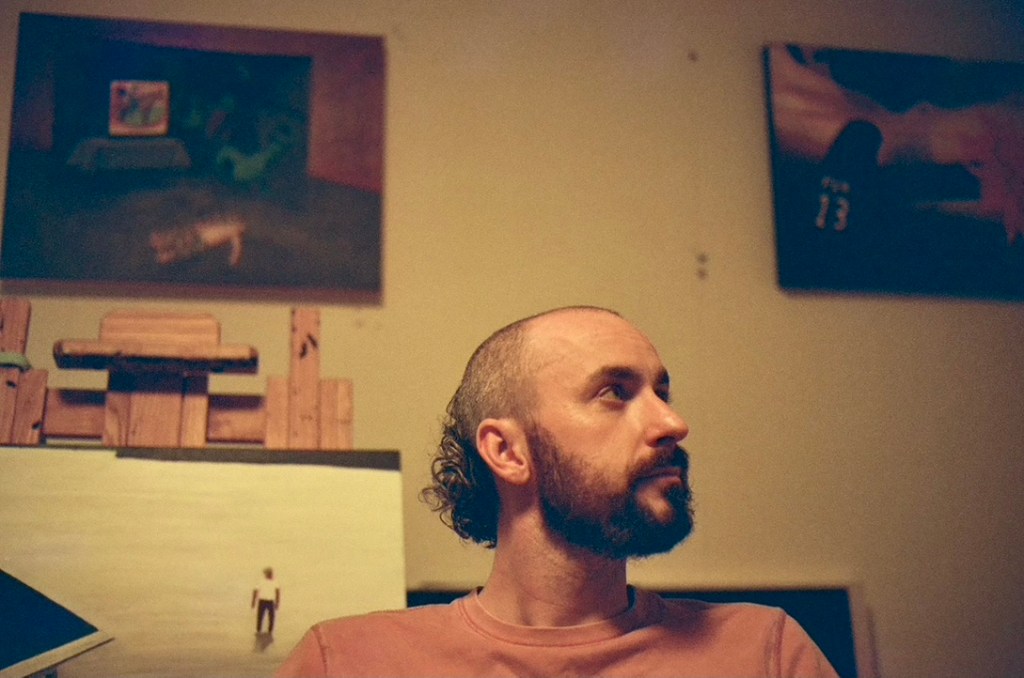
The first time I met Matthew Reed he sat quietly in the recliner while a party was happening. The house we were in was adorned with sketches on notebook paper, photographs of high school rock bands, and a Bruce Springsteen cover from The Rolling Stone. I later learned some of the paintings and drawings—all but a few were unframed and tacked to the walls—were done by Matt.
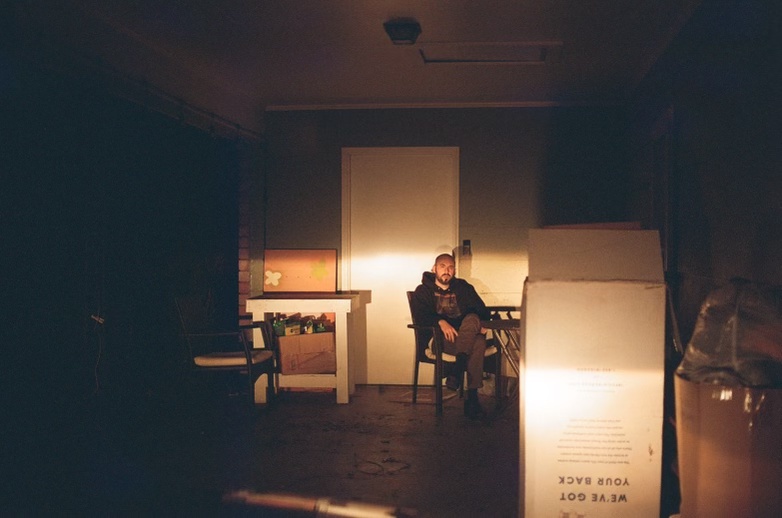
The musicians that lived there, Colin Miller and Lewis Dahm, built a space that was refuge for all types of inspiration in Asheville, North Carolina, but artists found a certain calling there: the living room Matt sat in the corner of was the studio for early Wednesday and MJ Lenderman records and through the years, several more songwriters came to record in the home studio.
Matt gave me a Coors while we sat with our group of friends and laughed at YouTube videos of intergalactic space babies dancing on their ships and bigfoot investigators unearthing new evidence. We eventually wandered outside in the August sun to grill hot dogs and talk. Matt told me that he had been at a reading I gave as a part of the Travelin’ Appalachians Revue in back in 2017 and enjoyed my work. He remembered me.
Matt is a deep, compassionate thinker which comes through in his generous responses to my questions. For this interview, we sat on the banks of the French Broad River; beside us, a silent train track crossing. We talked about how his experience between places and emotions informs his creative process and the way he sees the world.
EG: Where’d you grow up in the South?
MR: Dallas, Georgia — just outside of Atlanta. I grew up there until I was six. I used to have a mean Southern accent in me. I lost it when we moved to upstate New York along the St. Lawrence River, about 10 minutes from Canada.
EG: Did you grow up going to Canada often?
MR: No, never. We would sometimes be on the boat in between the waterways, so you could see Canada. But that’s it. We’d go up close to the shore occasionally, but I never really went to Canada. I’ve only been there
maybe a handful of times.
EG: Did you go to art museums on school field trips and stuff?
MR: We went to Watertown a lot. The [Fredric] Remington museum is there. Remington was a painter. I think he was a sculptor, too. But he used to paint… ugh, I can hardly remember. It’s like horses and shit. We’d go to Upper Canada Village in Canada which was kind of like this peasant village thing. They’d be like, cosplaying. I remember when we went, I brought a loaf of bread to bring home to my family and on the bus during the drive back, I just ate the core of the bread, just opened it up and dug it out. Just ate the meat of it, leaving the shell.
EG: What was the first painting you made?
MR: I’ve been drawing for as long as I can remember. I was super into drawing cartoon stuff as a kid and learning how to draw facial features. But I could never learn from other people. I think I have some sort of learning disability. I can never learn stuff from other people’s tutorials. I always have to go and do the thing myself. I think the first painting I made was probably something abstract.
EG: When did you take an interest in painting?
MR: Well, it was weird. I never really had a hardcore interest in painting. After college, I went through a very small stint of just getting high and painting abstractions. I think I made like a couple of those and then put it down for the longest time. Then in 2018 or 19, I started to do drawings again. They were humor based with funny little captions. Then it was the pandemic. I just, you know, got bored. Then, after doing it a bunch, I just slowly started adding paint. I didn’t know anything about painting. I didn’t know anything about the most famous painters. I knew Francis Bacon, and I think that’s about it. I still don’t really know anything about painting. I just found out about Bosch last week.
EG: What do you think about painting being considered “fine art”? Do you think that has something to do with rich people owning paintings?
MR: Painting has a lot of money attached to it. I think people are always surprised by how much paintings are worth. Ya know, a Rothko painting worth a fucking millions of dollars. I mean, I don’t know too much about the evaluation of that kind of stuff. I know there’s conspiracies about art being a way for the rich to launder money or something. Meanwhile all the artists that make it are generally starving in their lifetime or at best, scraping by. Maybe not starving exactly, but they’re not making a shitload of money. Painters are making something that’s practically inaccessible to their class. I just redecorated my house and was like, “Oh, I’ll just get some nice prints.” But you can’t find a print out there for less than $200.
EG: You sell a lot of the stuff that you make yourself. How do you appraise a piece you have done?
MR: I take into consideration that it takes a while to make it or how much time I spend on crafting something. I will value it to make it worth it for me. But I just don’t see a reason for me to sell a painting for a couple thousand or something if I don’t offer some affordable alternative, like a print under $100. Not everything you do has to be to make like a shitload of money, you know? But then at the same time, if it’s your sole income, you are probably not able to offer a painting or a print for $100. It’s just so weird how inaccessible it is for some people to buy a painting. I’m not saying I wouldn’t ever sell paintings for an absurd amount of money. I just don’t see myself doing that without offering an affordable, tangible option, like a print, shirts, or whatever. Art should be available to everyone, not just those who have money.
EG: What’s the quickest you’ve ever made a painting? And what’s the longest you’ve worked on one?
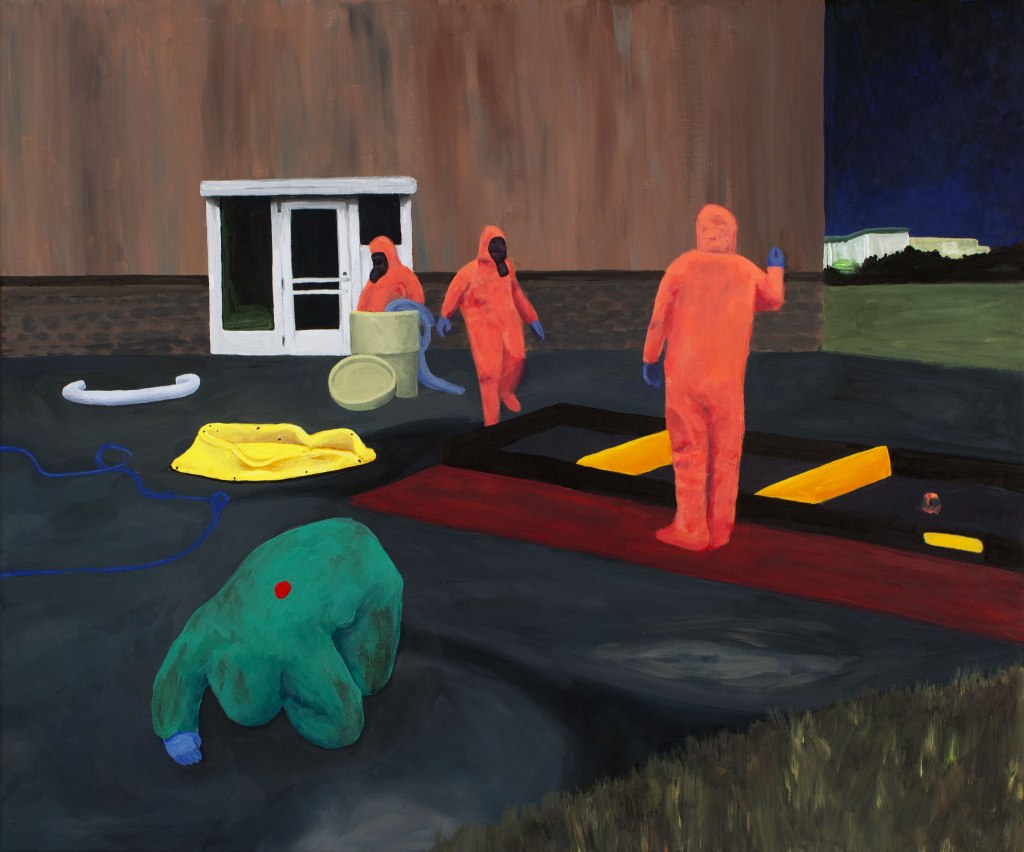
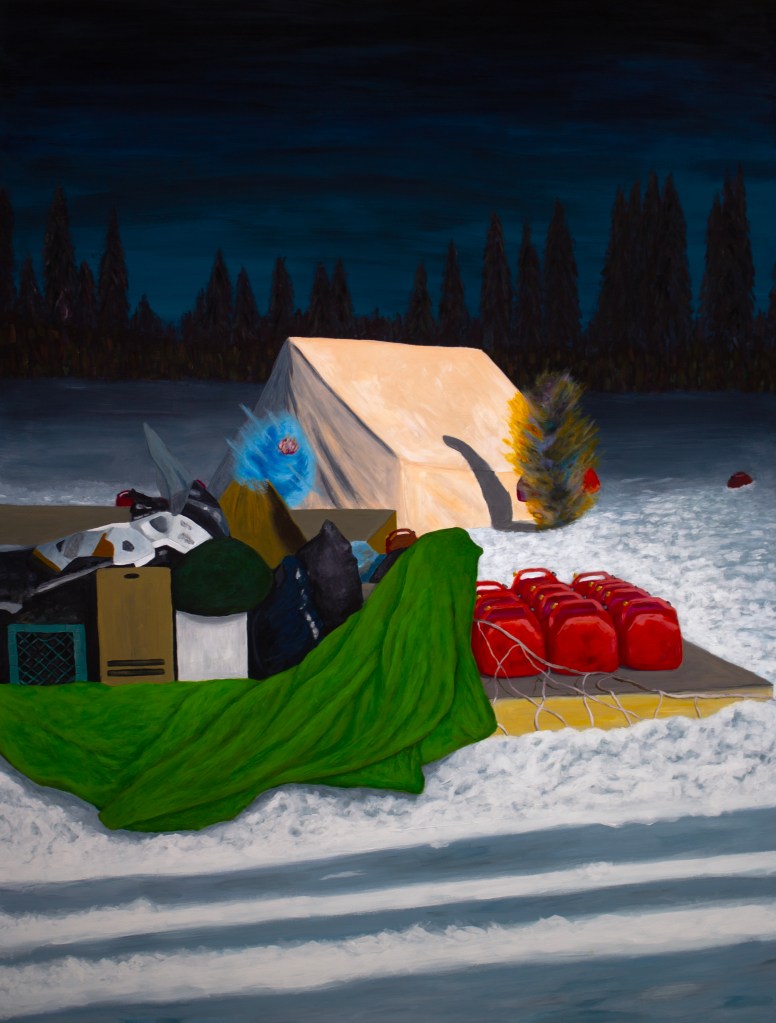
MR: Everything’s different. Probably, like, six hours. Hung Over on Jobsite was pretty fast. For the longest, It’s About Time took a while. A lot of revisions and reworking. Sometimes it can take me 15 to 20 hours. I think anything over that, I will just ditch. I’ll get bored of it and just realize it’s not working and try to move on. Sometimes I’ll try to keep mining something that doesn’t seem like it’s there. But I try not to ditch it right away. I try to sit inside of it and realize the feeling of the piece, and if it’s not working immediately, maybe it will be resolved over time.
EG: What does it feel like when something’s not working during your process?
MR: I can’t quantify it. It’s kind of like a general feeling that it’s not up to snuff on what it should be. You know, what I’m trying to convey is not there. I might think I need to try a different person or place or animal, or I just get distracted by a different idea. I’ll know I’m not going to revisit it and think that I could potentially finish this, but I’ve got this other thing going on I’m much more excited to work on. I try to show some self-discipline and sit with it. I’ve gotten better at finishing the original idea. There’s very few times I actually throw something out.
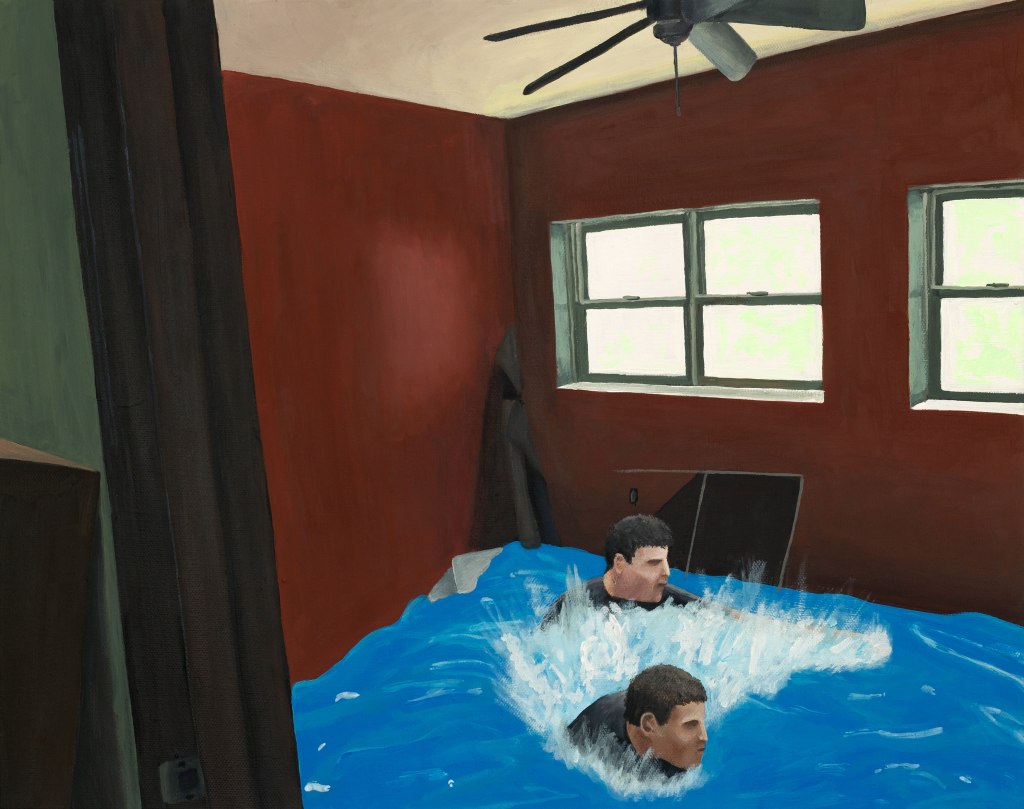
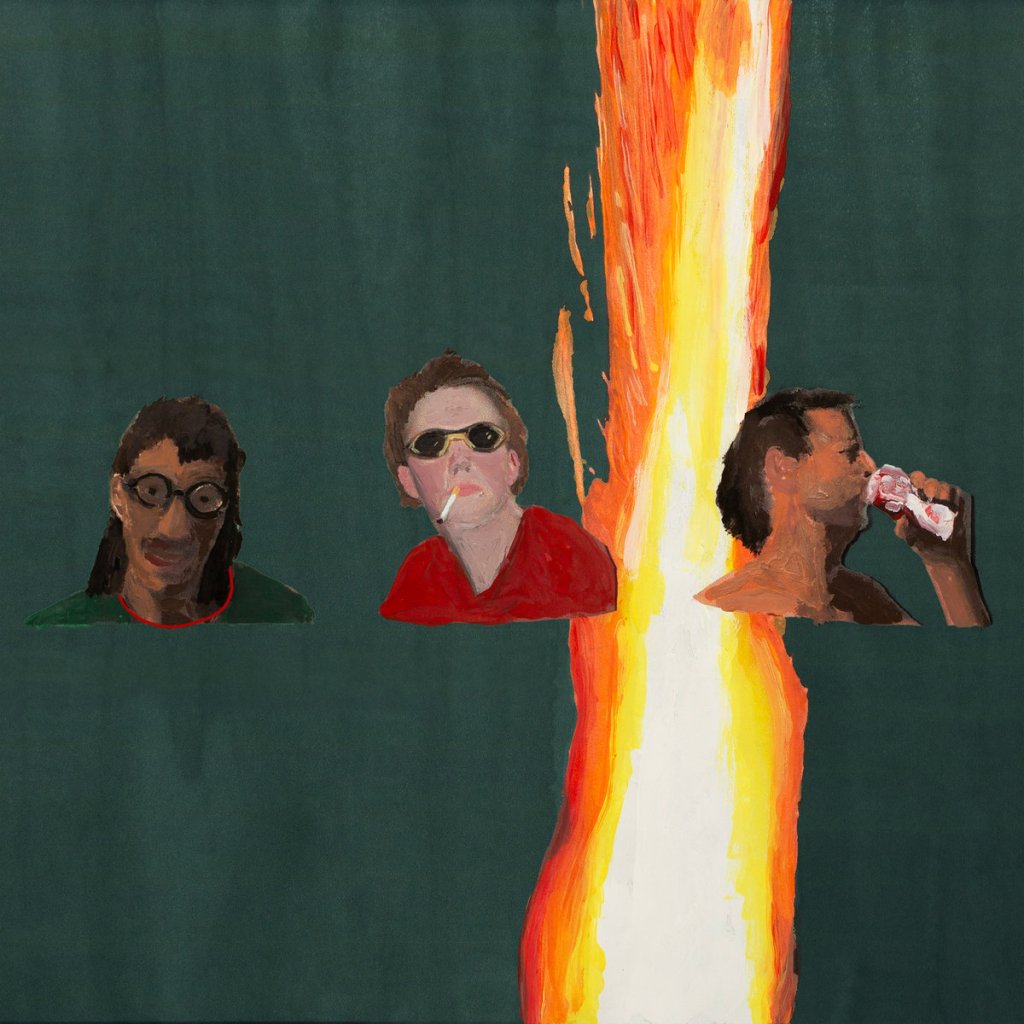
EG: The Brothers is one of my favorites. Where did that one come from?
MR: I found a room on Craigslist room rentals, I think from Watertown, NY. Then I made a composite image with a photo I had banked from the Chaumont, NY Fire Department’s Facebook. I’ve found that most fire department’s Facebook pages have the best photos to harvest from.
EG: Is your process pretty similar across the board? What precedes the painting to get you inspired to start.
MR: I spend a lot of time combing through found footage online and random people’s Facebook or random bars’ Facebook pages. I’ll generally see a person that’ll catch my eye or even an environment. Sometimes I’ll go to Craigslist to look at room rentals just to look for an environment that seems kind of liminal or daunting. I try to pay attention when I’m out in the world. I’ll take photos of stuff that catches my eye. I’ll just bank all that into a folder on my computer. And then I’ll just cruise the folder and find that person or scene. And usually I will make a draft image in Photoshop. I’ll start to blend a sublet room off Craigslist or a person into a composite where it’s both like and not like the way it normally is. It’s never a full idea at this point. After that, I’ll start painting. I’ll make gametime decisions after I paint that initial thing. Maybe adding more people or color as I’m working and spending time on it. So it’s kinda like a three part thing: scouring, sketching, and painting. This is just how I like to do it. I don’t know if I will always try to do it like this. I just get bored, so I’m open to trying to think of new ways.
EG: The smoothness of your paintings – both the lines and the finish – seems like they transfer really nicely to digital spaces. Is that something you consider, too?
MR: Yeah, I think painting is really easy to share digitally in an expressive way. I like seeing paintings in person because it’s so intentional: you’re sitting in front of it, and that experience is nice. But when I go to see art in person, I think I’m far more interested in parts of the exhibit that are sculptural. I think those are more inspiring. Sculptural, modern art can be a little controversial, like the adage of a bag of trash in a recliner. But there’s something bigger happening when you actually go and experience it. For me, they’re kind of a reminder of how free you can be. Even though they can be considered serious, they aren’t serious when I look at them. Or maybe they’re so serious that when I look at them, they seem irreverent. When I look at these types of installations, I just think of the infinity of the mundane shit I have to do just to survive. I was in Berlin last year and saw this exhibit by Fred Sandback, whose whole thing was string sculptures. He had a couple of rooms with geometric shapes laid out, using just two to four pieces of colored string. That was like the whole thing. It was amazing. It’s a reminder of how fleeting all of this is, and that your art doesn’t have to be something overly intricate.
EG: Whenever someone sees a Matthew Reed painting, what do you hope they experience?
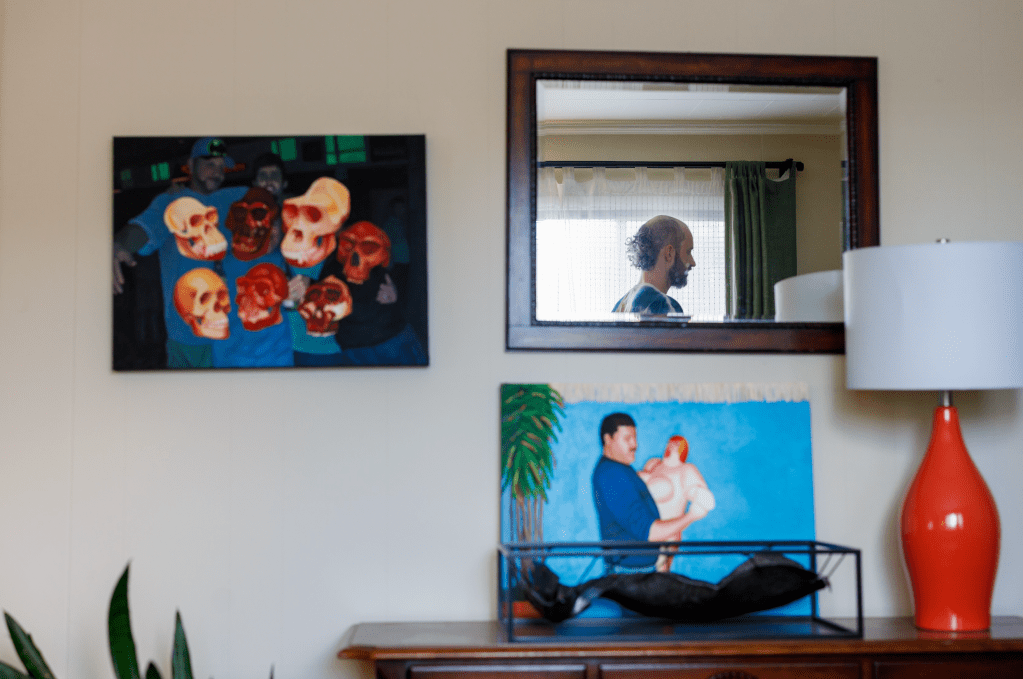
MR: That’s a big question. I think probably most of my stuff has a tinge of comedy. Absurdity, maybe. Like a feeling of deep introspection and humor all wrapped into one. It’s almost like I want people to be in a limbo space where you’re not too sure. Maybe you go to this space between feelings. You probably want to laugh, but you don’t know if that’s the right response. You don’t know if there’s something darker going on. I don’t feel like my stuff is dark, but it’s got the feeling of isolation that I want to keep. I guess.
EG: Do you listen to music while you paint?
MR: Oh, it depends. Most of the time, I’ll watch movies. I just rewatched Love Liza (2002), which is a great movie with Philip Seymour Hoffman, where his wife dies and he gets addicted to huffing gasoline and remote control planes. I like to watch a lot of dark comedies. Stuff like Todd Solondz’s Dark Horse (2011). This way I can get away with watching a shitload of TV and not feeling bad about it. I can’t sit down and watch TV anymore. I feel like I could just be doing the same thing but painting.
EG: Are you drawing from this stuff while you work?
MR: Sometimes. I like music and books that do that, too. I think that’s what I enjoy about people like Harry Crews and Todd Solondz. I find that kind of stuff relatable, kind of like a nuanced examination of ignorance and loneliness. With Crews particularly, I’m interested in how he really doesn’t say if he thinks certain people or ideas are morally good. It’s just that these types of folks exist. I think that that’s a really important part to my reading of his deplorable characters. I think he’s probably trying to make the point that they are just as lost as somebody who we perceive to have their shit together. A morally operating person. And yet, on a human level, maybe there’s something redeeming in the fact that we are all just kind of lost in the world.
 Quarter Notes Magazine