
What Are You Gonna Sing?
an essay by Juliana Feliciano Reyes & Bea Troxel
“You’re So Vain”
Bea,
I go with Carly a lot. “You’re So Vain.” But it’s kinda my basic boring choice. I know it from childhood—from How to Lose a Guy in Ten Days, where Kate Hudson does an unhinged version with Matthew McConaughey right before their big fight. Inspo, I suppose, for being a mess. But wait, I’m not trying to be a mess! I just want to be less fixated on being good.
It’s hard to do karaoke when you know you’re a good singer. I know you understand this. I’m not the best singer, but I was once the lead in the high school musical and I know my strengths. I know I can do the husky sexy low-range stuff. And my whole life I’ve tried, pathologically, to be the best at whatever I did. Or maybe what’s more relevant here is that my whole life I’ve been terrified of looking like a fool. Being the person who thinks she’s killing it but is actually pretty mid? Oh my god, that’s my worst nightmare.
Unfortunately I’ve come to realize that looking like a fool is what karaoke is all about. More precisely: being OK with looking like a fool. This is not America’s Got Talent. It isn’t that serious. You’re supposed to have fun. It is not fun to be outside the piano bar frantically googling YouTube videos of “You’re So Vain” and going over the lyrics and making sure you can hit the notes. Not that I did that. That was for a different song, “In Dreams” by Roy Orbison, which, I learned, probably just don’t sing it. It’s very hard.
My best friend Bee (another Bea/Bee!) loves this karaoke piano bar in lower Manhattan, Sid Gold’s. We went a bunch of times one year, every time I’d visit. You sing with the piano, like at an audition for a musical, on a stage in front of everyone. Now let me say that, in a lot of ways, this is a dream for me. Singing on a stage to a bunch of strangers.
But Sid Gold’s brought out some kind of animal in me. I wanted to be not only good but alluring and entertaining but not so serious that it wasn’t cool. I was terrified of looking dumb. I needed to perform, or else.
We brought a pair of boys there one night in our twenties, and I sang “You’re So Vain,” the one song I knew I could deliver on, even if I always slip up on the third verse. This was the song I chose, the safe song, in my bid to make my date love me. I’m not sure it worked.
Years later, Bee got married and took us all to Sid Gold’s the day after the wedding. I watched in awe as her new husband sang Radiohead’s “Creep.” He… wasn’t very good — his voice, I mean. He spent a lot of time with his eyes closed. Wailing. Overdramatic. Moving about the stage in an erratic fashion. But he was a star up there. He seemed not to care at all what the audience thought. Of course, they loved it.
As I watched, I was filled with envy, and then sadness that I could never be up there like that. That would never be me.
Or could it?
“I Can’t Make You Love Me”
Juliana,
Yes, I know exactly what you mean when you say karaoke is hard when you can sing. People often say, “You must be so good at karaoke!” And I always respond with: “That’s not what karaoke is about!” Because it’s not. Karaoke is singing while looking at the crowd; it’s knowing where your limbs are; or it’s not singing well and not moving your limbs well but in a confident manner. Like the “Creep” performance you mentioned.
I think I found Bonnie Raitt’s “I Can’t Make You Love Me” as a cover first, maybe the Bon Iver version. It stopped me in my tracks:
“I’ll close my eyes, and then I won’t feel / the love you don’t feel when you’re holding me”
Devastating as it is, I sang it first at a karaoke bar in Harrisburg, PA, fresh out of college nestled to the side of the room, not moving my arms, swaying to myself. The lights were low, and almost no one paid attention as I sang. It felt safe, comforting. And then later that year in downtown Nashville, at a bachelorette party in a back-alley karaoke bar. Afterwards a man walked up to me and said, “That was so beautiful it made me want to slit my wrists.” He was hitting on me, and he seemed to be letting me know two things: one, my performance attracted him, but two, that it was sad. It was a sad song.
When I first started living in Harrisburg, someone in the town saddled me with the title Sad Cowgirl. And when my first girlfriend wrote about me in a literary journal, my alias was Sad Cowgirl. I’m the sad singer. I write sad songs. But that has felt limiting, always like a disclaimer before a set: “Watch out, these songs are sad.” But I love sad songs—in fact, I almost always prefer a sad song to an upbeat song.
When I sang “I Can’t Make You Love Me” most recently, at our grad school residency in the hotel conference room, I spent one hour going through my phone looking at the songs that might be fun. Abba? No, what about Backstreet Boys? How about “Dreams”? None of them were songs I wanted to sing. I couldn’t get behind them. I didn’t want to sing a song I don’t care about, but I also wanted to pick a song other people cared about, so at the last minute I chose Bonnie Raitt.
Karaoke gets at the question that I’m often asking myself: how much for me? How much for others? I have to adhere to the fact that other people will be listening to me. Karaoke is a performance, so it’s about me and it’s about others. Which is why my gut goes to sad songs and then my mind thinks: oh, I must entertain everyone! So then I feel my way through options: Ed Sheeran? Fleetwood Mac? And I almost always end up back at Bonnie.
At residency, people are with me as I sing, I’m with me as I sing, and when I get done, a faculty member (you know which one) says, “That’s the saddest song that’s ever been written!” I look down a little shamefully and say, “I know, I know, I know.” And he says, eyes wide, “No! I teach that song as the saddest song that’s ever been written! I love that song.” It’s framed as a compliment this time — the sadness.
I would not call “Creep” an upbeat song. It’s heavy, the guitars get thick and crusty, but it’s in a minor key, it’s moody, warbly. That man you described was inside of the song. And that’s the thing — the element that is for others usually works if the person has first chosen a song they love, one they can get into, even if it is sad.
“Mr. Cellophane”
Bea,
I remember when you sang Bonnie Raitt and when the faculty member said, well, yelled, really, “That’s the saddest song that’s ever been written!” And you were apologetic. Like, I’m sorry to bring you there. Perhaps you know you have that power. For some reason, it happens whenever I hear you sing: Tears pool in my eyes. I have not historically been a big crier, but now I feel grateful when it arrives. Worried that no one wants to go there, to the dark place, you ask: How much for others? But it strikes me that delivering us intense emotion is so much for us. A gift we don’t know we need.
What am I delivering, what do I want to deliver? A long lost karaoke memory came to me last week. There was one night, almost ten years ago, when I hosted a reading at a bar and the evening gave way to a karaoke night. Bee surprised me, came down from New York for the reading. (Actually, this was right around when she began dating the “Creep”-singing man.)
I sang “Mr. Cellophane” from Chicago because I knew it would make her laugh. I didn’t know any of the dialogue, just the chorus, just the dance move John C. Reilly does in the movie version, the most pathetic little jazz hands flapping around his head. I fumbled the song and giggled throughout, a bit embarrassed, sure. But was it my best karaoke performance to date?
How much for me, how much for others, or how much for one special other, whose joy is tied to yours.
I can’t believe I had all but erased this one from my karaoke narrative. I guess I can be a fool after all, if the conditions are exactly right.
“Jackson”
Juliana,
In the clip of John C. Reilly singing “Mr. Cellophane,” he paints his face white with red circles on the cheek — a clown getup. I’m watching it now. It’s silly, his movement, his lurching, and it’s funny to imagine you so short and young doing this same dance.
What also strikes me is that for you, karaoke has been an art of perfection: singing the perfect tunes with your show tunes voice. And yet, your rendition of this song must’ve been silly, lilting, and I’m struck by how you forgot this, and how we are always learning the same lessons over and over. For you, you’re asking how much for yourself? But you’ve been choosing yourself all along, choosing the messy versions for the joy of the delivery and the joy of the bit.
Since you mentioned your best performance, I think my most successful karaoke songs have been duets — ”Jackson” with my dad, “This Must Be the Place” with a friend, LT. By successful, I mean that both the crowd and myself were pleased. Every February my parents’ church has pancakes and karaoke the night before Lent, and my dad and I always sing a duet.
Picture it: yellow fluorescent lights, tables sticky with syrup, children screaming “Let it Go!” (They had to put a cap on how many times the kids can sing the song — only once now.) The priest says into a microphone, “And now, the returning husband and wife duo: Scott and Bea Troxel!” Everyone gasps and she blushes and corrects herself, “The return father-daughter duo!” We walk onstage red-faced, and proceed to sing, “We got married in a fever” multiple times.
It’s in my dad that I see myself — painfully so. His face gets red, his vibrato warbles as he sings, he’s focused on doing a good job. He flashes me a nervous smile between lines. We both want to perform so well, but the desire to impress locks up our limbs. The crowd cheers wildly as we leave, and I let out a giant sigh.
“Criminal”
Bea,
After karaoke at residency last winter, after our performance anxieties warbled about us, twinning us, and after we survived just fine, you said we should sing a duet next time. Now I’m newly flattered by this offer.
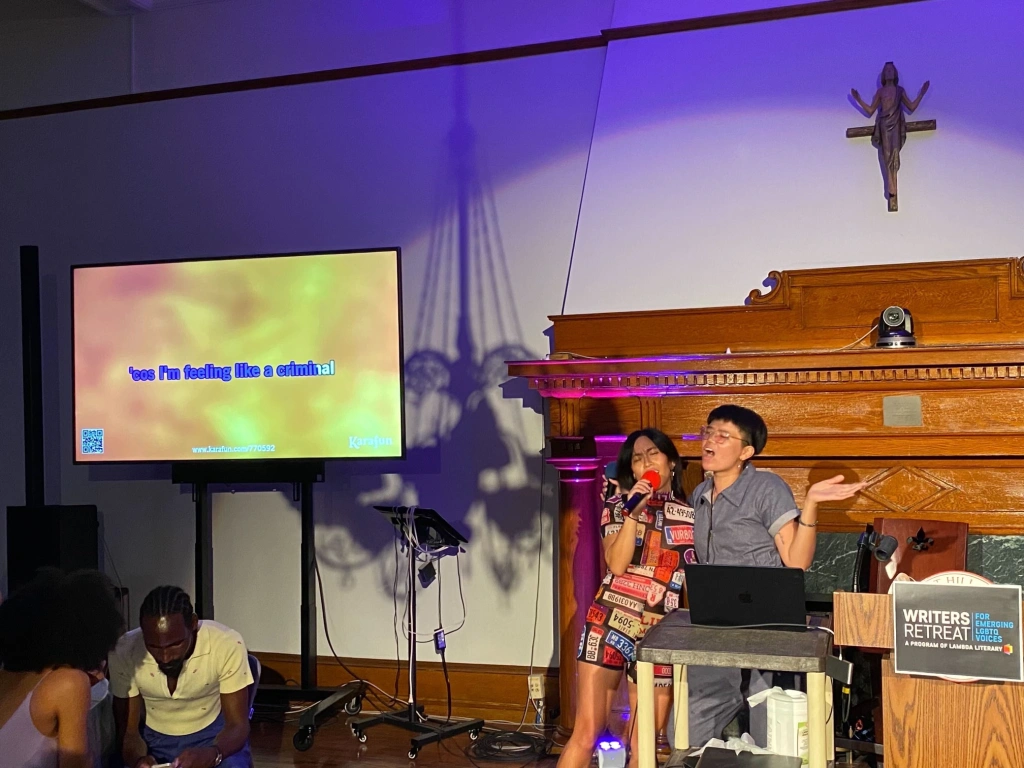
I sang a duet at another literary retreat last summer, though the song — Fiona Apple’s “Criminal” — is not a duet. My friend Min and I turned the song into one, in an act of solidarity. The week-long retreat felt like summer camp in the best and worst way, which meant the prospect of singing in front of everyone terrified me and at the same time, I wanted badly to do it. I wanted everyone to look at me. And I was afraid to do it alone.
Picture it: The ballroom at the Catholic college, the wood-paneled one we returned to every night for readings. Cans of White Claw and plastic cups of wine litter the tables. Jesus hangs over the wooden podium, our makeshift stage. It’s the last night of big gay summer camp and the energy is crackly, a little dangerous, with the possibility of one more chance. What I mean is the stakes are high.
I’m wearing that insane sheer bodysuit, the one with all the license plates, that we got at the thrift store together last summer. My hair newly shorn, chopped first by the Gen-Z gaysians and then cleaned up by Min. My crush in the crowd, pacing.
One of the mics malfunctions. So I take charge and grab the working one, suddenly emboldened by the stage. Min puts her arm around me. We sing so close it’s almost as intimate as me sitting at her knees, waiting for her to finish cutting my hair.
But Bea, I have to confess I didn’t let go of the mic. Just moved it between us. Made sure I got some solo time. Was I being a diva? Well, yes. A little.
“This Must Be the Place”
Juliana,
This is exactly what we’re both trying to get at! How do you sink into a moment when the stakes are high? Or how do you sink into a moment that you chose? It sounds like you did with “Criminal.”
I return to my other duet, Talking Heads’ “This Must Be the Place,” that I also sang at a writers’ residency. My friend LT and I wanted to sing a duet, and they thought of this song a few days before karaoke. Juliana, you were out of town for this, but I remember feeling so nervous because I’d just met everyone a few days before.
As we waited for our turn, we watched many spirited performances: a wild version of “Crazy” by Gnarls Barkley and a hearty “Purple Rain.” And then LT and I went up, and of course, my hands were sweaty and my limbs stiff. The song leads in with a synth flute, and they started bobbing their shoulders. So I started bobbing my shoulders. Soon enough we were bobbing and singing, “Ohhhh, I got plenty of time.” And they were harmonizing and we were waving our arms and people had joined us on stage, bopping awkwardly around us.
And in that moment I felt a freedom. I let go. I sank in. We crooned into the mics.
 Quarter Notes Magazine