
Sailing the Seas with Rembrandt
by Evert Wilbrink
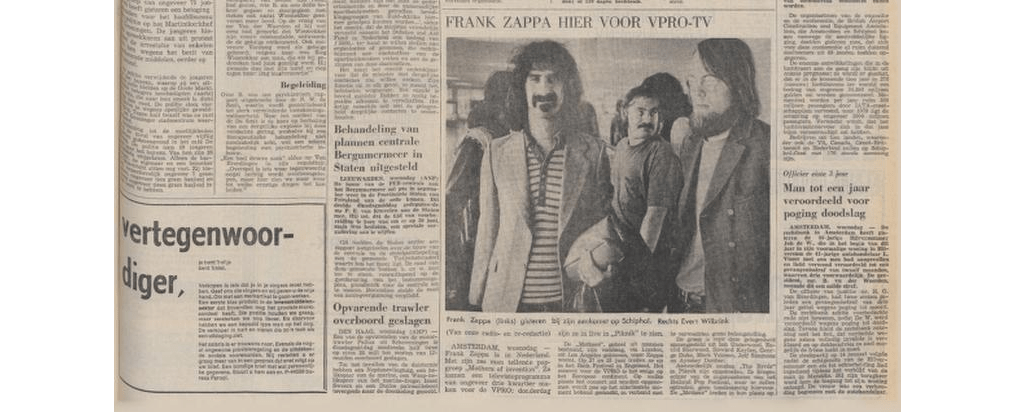
Frank Zappa, Howard Kaylan, and himself
For more than half an hour they stood in line to buy a handful of bingo cards for $72. Mostly American pensionados. They had left their red MAGA caps at home. Later that evening I saw quite a few of them in the casino on the fifth floor of our cruise ship. And the next day I met many now familiar faces at the unveiling of the art that would be auctioned on board that week. The quality of most of the works exhibited was only slightly above the level of what used to be on the wall at Hobby Lobby to promote its framing service. I’m not an art connoisseur, but I noticed that the paint was just a little thicker than the landscapes on the wall of our neighbors in the socially deprived neighborhood that I grew up in. Art for less than five hundred dollars. I asked one of the gallery staff if there had been any bids on anything and found that a number of generic works already sold for a thousand greenbacks and more.
The cruise line we’re on has an exclusive deal with Park West gallery. Their art follows us everywhere: in the corridors, at the buffets and around the shopping promenade. After some further questioning, it turns out that the same gallery owner has deals with all other cruise lines, branches ashore in Chicago, New York, Hawaii and at Cesar’s Palace Casino in Las Vegas. In other words, more than a hundred points of sale. To keep things running smoothly, Park West has a 22,250-square-foot warehouse in Florida, from where more than 300,000 pieces of art can be shipped annually. Casino-guests and cruise-goers are apparently an easy art audience.
A day later, a flyer posted on the door of our room summons us to a special exhibit of two series of lithographs by Mr. Dali. We had seen some of these a month earlier, hanging at an art shop in London: works inspired by Dante’s comedia del arte. Some with the signature of Mister Moustache underneath, some without. Those without are significantly cheaper. On the opposite wall, some prints by Picasso. One is signed, but not by Pablo himself.
“Where do these come from?” I ask an employee, neatly dressed in a suit.
“These are prints of work he gave to his granddaughter,” he answers, “That’s why we also tell you: From The Collection of Marina Picasso.” And in relief print I see at the bottom, on the right side: A limited edition after a work by Pablo Picasso. Loosely based on a work by Picasso, hmmm… In my head rings the disclaimer of many radio and TV commercials: Past results, etc.
I think back to the late Bé, one of the best-known sellers of Herman Brood’s art, who once uttered the famous words: that’s what we call money printing. I don’t remember if he said that before Herman’s jump from the Hilton or after. And wasn’t there once a scandal in Amsterdam involving lithographs by Karel Appel? Karel described his work as I just mess around, but after his passing, a few art gangsters really made a mess of it. Some lithos were printed on sheets that Appel had signed in advance, others were graced with signatures that Appel must have set after his death.
“B41!” shouts the bingo master. “Janis Joplin, Jim Morrison, Amy Winehouse,” he continues. “So… number 27!”
Someone shouts: “Bingo!”
“We have a Winner. You won $162. I would immediately go to the galleria to invest in arts and maybe turn it into thousands!”
In the bar, you can answer a trivia question and possibly win a prize, which you can verify at the art auction. So, we’re going there too! And… what the heck? Two etchings by Rembrandt! One of these is a self-portrait, I estimate twelve by eight inches. My heart starts beating faster: I have a thing for self-portraits of Mr. van Rijn.
A thing? Here’s why…
Once upon a time, there was a very strange singer named Captain Beefheart. Better known at the Civil Registry as Don van Vliet. Those who appreciated Absolutely Free by the Mothers Invention in 1967, and continued to evolve in the progressive direction with Frank Zappa, may also have bought Trout Mark Replica by Captain Beefheart & His Magic Band on Zappa’s Straight Records label in 1969. Don had recorded a number of interesting albums before, but with so little success that the next few months he earned way better as an itinerant salesman of vacuum cleaners. One day, by chance, he rang Zappa’s doorbell, who recognized him and asked what he thought of the vacuum cleaner business. It sucks, according to Don. A few years later, Captain Beefheart lost his Magic Band due to, again, lack of success. But Virgin Records, Richard Branson’s record label, gave him another chance – and Don recorded two albums with what was later referred to as the Tragic Band.
I worked for Virgin in the Benelux and accompanied the Captain to Sjef Van Oekel’s Disco Corner, and later to TopPop TV. We spent one night at the Museum Hotel, where he told me all about his former wanderings in the city. Fairly believable stories that smacked of the Golden Age. “I am Rembrandt reincarnated,” Don explained with the jaunty air of Harmenszoon van Rijn. So, it surprised me little when Don would later give up his musical career for a life with linen and paint. I saw it coming.
When three decades later I returned to the Netherlands with my new American wife Deborah for a Christmas visit with the family, I had long forgotten about Captain Beefheart. It was bitingly cold in Amsterdam, and to warm up we fled into the chaotic Rijksmuseum, which was in a permanent state of renovation at the time. The Night Watch was one of the few works that the audience could warm themselves to, and while Deborah continued a hypnotized gaze at the masterwork, I yelled: “Damn, what the heck!” Next to The Night Watch hung a small painting. Don van Vliet was looking at me! A self-portrait of Rembrandt! The same face I looked into when he sang “Upon the My-Oh-My” in ’74 on TopPop TV: “Hands low, hands high, upon the My-Oh-My / Got to make her roll, got to make her fly / Now tell me, good Captain, how does it feel / to be driven away from your own steering wheel? Upon the My-Oh-My…”
Two floors below the wheelhouse of our cruise ship, I loiter around Rembrandt’s self-portrait for a few days. Humming “Upon the My-Oh-My.” In the waters around Iceland, around Greenland, and also tonight, just off the coast of Newfoundland. It looks like an etching – but you can’t feel it: it’s behind glass. I recognize it as The Standard Bearer. I get a note with $3900 written on it. Not bad for a canvas that was purchased for the Rijksmuseum in 2021 for 150 million. But what about it, who created this etching after the painting? Is it a black and white reproduction? Or maybe a preliminary study? There are many known lithographs by Rembrandt, often from the same plate, sometimes etched by the master, sometimes printed by his students, occasionally centuries later. And sometimes signed, but mostly after his death.
Before the Beatles brightened up the walls of my boyhood room, they were adorned with works by Van Gogh, cut out of women’s magazines Margriet and Libelle. I don’t think there were any posters on sale yet of Sunflowers or Starry Night at that time. The word merchandize had not yet been invented. Just like the Beatles curtains, Van Gogh’s work was thrown away at some point. But what would these have been worth? Another $3900? Or does the beautiful frame, in which Rembrandt’s Standard Bearer will reach its new destination, make the difference?
Our American cousin Harold, also on the cruise, is looking at it as a potential investment. How much will it bring in ten years from now? I explain to him that there is quite a difference between purchasing and selling. The gallery makes a steal selling, and in time, another major cut when buying it back. And that ten years from now so much more art will have been reproduced. Wouldn’t you rather buy a painting where you can scratch off the paint with your nail?
While my Deborah is sitting with her nose in a book about the downfall of the dignity of needlework during the industrial revolution, I wonder whether the muse, Art, can continue to hold on to its capital letter despite the industrialization of the art trade. The Artist himself has probably already given up almost all hope of respect overhearing a customer wondering whether his art goes with the color of the sofa.
In the Archivio di Stato di Pisa this month, about 2100 works of art are displayed that were confiscated last year because they didn’t feel totally kosher. The room with the Picassos has the same atmosphere as the gallery on our boat, but the attendant here makes no attempt to lure the visitors into a brilliant investment.
 Quarter Notes Magazine